
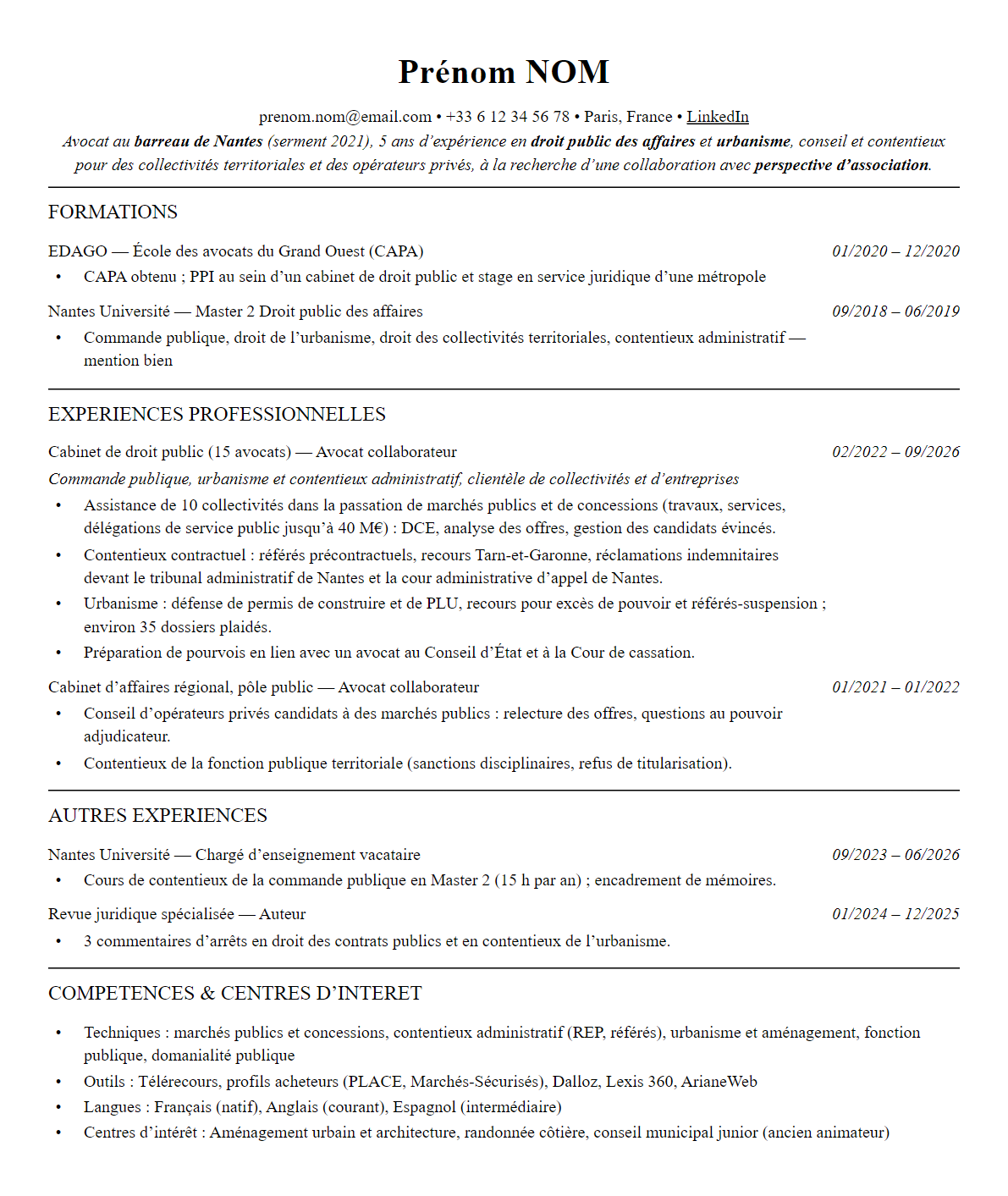
Public law lawyer CV in France: administrative litigation, public procurement, planning
Public law attracts a wide range of profiles: graduates of political science institutes (IEP), in-house lawyers from local authorities, business law associates who have spent time in a "public sector" team. Yet firms recruiting in this field expect common ground: command of administrative litigation, precise knowledge of public procurement and, increasingly, experience of planning and environmental law. Your CV must show where your centre of gravity lies and prove that you understand how proceedings before the administrative courts work.
This guide covers what partners look at, a structure that works, and how to present sensitive matters, often involving public bodies whose actions are closely scrutinised.
What public law partners look for
Administrative litigation, the foundation
A partner wants to know whether you can draft an originating application, a statement of defence or a post-hearing note, and whether you know the urgent procedures of the Code of Administrative Justice: suspension proceedings (Article L. 521-1), fundamental freedom proceedings (Article L. 521-2), and pre-contractual and contractual summary proceedings (Articles L. 551-1 and L. 551-13). They also look at the levels of court you have dealt with: administrative court, administrative court of appeal and, for appeals on points of law before the Conseil d'État, working with a specialist Conseil d'État and Cour de cassation lawyer (avocat aux Conseils), whose involvement is in principle mandatory.
Public procurement
Public business law firms advise both contracting authorities and bidders. The skills sought are practical: drafting tender documents, evaluating bids, securing procedures under the Public Procurement Code (in force since 1 April 2019), concession contracts, litigation over award and performance, and third-party challenges to contracts.
Planning and development
Building permits, local planning documents, development schemes, compulsory purchase: these matters combine advisory and litigation work. Partners look for familiarity with the specific rules of planning litigation, such as the obligation to notify challenges under Article R. 600-1 of the Planning Code or the standing requirements of Article L. 600-1-2.
Positioning: public bodies or private operators
A firm acting mainly for local authorities does not read a CV the same way as a firm representing developers, energy operators or construction companies. State clearly the type of clients you have worked with.
Related areas
Civil service law, public liability, public property, State aid and environmental law all broaden your profile. The CNB (national bar council) notably distinguishes specialisation certificates in "public law", "environmental law" and "real estate law".
Recommended structure
- Header: contact details, bar, year of swearing-in or trainee lawyer status.
- Positioning: "Associate, public law — public procurement and administrative litigation".
- Experience: for each role, one line on typical clients (public bodies, private operators), then three to five lines organised by practice (litigation, procurement, planning).
- Education: Master 2 in public law, public litigation or planning law, CRFPA, IEP degree if relevant.
- Skills: languages, databases (Légifrance, ArianeWeb, Doctrine, Dalloz), use of Télérecours (the administrative courts' e-filing platform).
- Publications, teaching, where relevant.
To save time, a template already follows this organisation: open the pre-filled public law lawyer CV.
Describing your matters without breaching professional secrecy
A public body's name is still protected
It is tempting to think that a matter involving a public body is public by nature: council decisions are posted, some legal services contracts are subject to award notices, administrative court judgments are published. That does not lift professional secrecy. Article 2 of the National Internal Rules of the legal profession (RIN) specifies that it covers client names, with only one exception: citing named references in a tender response, with the client's express prior consent. A CV sent to a firm does not fall within it.
The risk of identification is also high: a challenge to a shopping centre project in a mid-sized town or the termination of a public service concession can often be recognised from regional press coverage.
The method
- Describe the client by category: "a metropolitan authority", "a public hospital", "a civil engineering group".
- Characterise the contract or project: "public transport service concession", "global performance contract", "development scheme in a joint development zone (ZAC)".
- State the court and procedure, without case numbers.
- Give an order of magnitude if it does not identify the project.
- Leave out the name of the town or the infrastructure.
Before / after examples
Procurement, contracting authority side
Before:
Drafted the tender documents for the city of X.
After:
Assisted local authorities in awarding works contracts and concessions: drafted tender documents and bid evaluation reports, secured procedures under the Public Procurement Code.
Pre-contractual summary proceedings, bidder side
Before:
Won a summary proceeding against region Y.
After:
Pre-contractual and contractual summary proceedings for unsuccessful bidders (civil engineering and urban cleaning sectors): analysed bid evaluation reports, drafted applications, argued before the administrative court's urgent applications judge.
Planning
Before:
Litigation over the permit for project Z.
After:
Defended property developers against challenges to building permits: statements of defence, applications under Article L. 600-7 of the Planning Code, regularisation during proceedings.
General administrative litigation
Before:
Handled cases before the administrative court.
After:
Represented public institutions before administrative courts and administrative courts of appeal: hospital liability, civil service, public property (around twenty ongoing cases).
Candidate from the public sector
Before:
Legal officer at W town hall for five years.
After:
Legal officer in the legal department of a local authority with more than 100,000 inhabitants: managed litigation and external counsel, secured council decisions, advised departments on public procurement.
Common mistakes
- Assuming any public matter can be cited. The publicity of an administrative act does not lift the lawyer's secrecy.
- Confusing urgent procedures: pre-contractual summary proceedings are not suspension proceedings, and a public law partner will spot the error immediately.
- Calling every public contract a "public procurement contract", when the distinction between procurement contracts and concessions entails different regimes.
- Calling yourself a "public law specialist" without a certificate. Article 10 of the RIN reserves the term for holders of a specialisation certificate issued by the CNB. Refer to your "main practice area" instead.
- Using former judicial functions as a selling point: Article 10 of the RIN prohibits any reference to judicial functions in lawyers' communications. On a recruitment CV, present them in strictly factual terms.
- Overlooking Télérecours, which firms take for granted.
Tailoring your CV to the firm
Firm dedicated to public bodies: highlight your understanding of how local authorities work, advising elected officials and departments, and securing administrative acts.
Public law team in a business law firm: emphasise infrastructure, energy and public-private partnership matters, and your ability to work with finance and corporate teams.
Planning and development firm: focus on permit litigation and development schemes, as well as neighbouring areas. Our guides to the real estate lawyer CV and the environmental lawyer CV will help you connect these skills.
Are you a trainee lawyer? A placement with a local authority or an administrative body as part of your individual educational project (PPI) can be an asset; our article on choosing your PPI placement helps you align it with your law firm internship.
Conclusion
A convincing public law CV shows your command of administrative litigation, specifies your procurement or planning practice, and describes each matter by its legal nature rather than by the name of a public body. To start from a structured base, open the pre-filled public law lawyer CV.
Frequently asked questions
Is an IEP degree useful on a public law CV?
It is common in the field and valued for the administrative culture it brings. It does not replace a Master 2 in public law or the CRFPA, but it deserves a line in the education section.
How do I present experience as a local authority lawyer before joining the bar?
Describe the responsibilities you held (litigation managed, tender procedures secured, advice to elected officials), the size of the authority and the scope of the department, without naming the authority if the matters described would identify it.
Should I mention working with a Conseil d'État lawyer?
Yes; it shows you followed a matter all the way to the supreme court. State your role, for example preparing the file and the factual elements passed on to the avocat aux Conseils.
Can public procurement and planning appear on the same CV?
Yes, this is common. Organise your experience by practice so the partner can quickly identify each skill, and put first the one that matches the firm you are applying to.