
Real Estate and Construction Lawyer CV in France: Structure, Examples and Mistakes to Avoid
Real estate law in France covers very different practices: commercial leases, transactions and off-plan sales (VEFA), property development, co-ownership, construction disputes and planning law. A partner reading your CV first wants to place your practice on that map. Within a minute, they want to know whether you have handled a ten-year liability (garantie décennale) claim, attended court-appointed expert meetings or negotiated a lease on a building still under construction. A CV that simply says "real estate law" does not answer that question.
This article helps you build a CV that makes your practice readable without ever disclosing information covered by professional secrecy.
What partners look for in real estate lawyers
Advisory or litigation
The first dividing line is simple: are you mainly a drafter and negotiator, or mainly a litigator? Many real estate teams do both, but the recruiting partner has a specific need. A firm advising property investors on acquisitions expects fluency with preliminary sale agreements, title due diligence and leases. A construction team expects knowledge of the French builders' liability regimes (one-year completion warranty, two-year warranty, ten-year liability), of mandatory building damage insurance (dommages-ouvrage) and of court-appointed expert proceedings.
State this orientation in the CV title: "Avocat – real estate, commercial leases and lease litigation" says far more than "Real estate lawyer".
Type of clients
Without naming anyone, you can describe client types: developers, institutional investors, social housing landlords, retail tenants, co-owners' associations, public or private project owners, construction companies, insurers. This tells the reader a lot about your instincts: a lease is not drafted the same way for a landlord as for a retail chain.
Real autonomy on files
The partner wants to know what you do on your own. Have you drafted written submissions as first draft? Attended expert meetings alone? Held the pen on a preliminary sale agreement? Your responsibility vocabulary ("drafted independently", "under partner supervision", "direct client contact") must be accurate: it will be tested at interview.
Certified specialisation, if any
The French National Bar Council (CNB) awards a "real estate law" specialisation. According to the CNB 🔗, it requires at least four years of professional practice and a competence interview before a panel. If you hold it, put it in the header. If you are preparing it, do not present it as obtained. Our article on the CNB specialisation explains the process.
Recommended structure
For an associate, one page is enough up to around five years of practice; beyond that, two pages are acceptable if the second one adds useful matters rather than repetition.
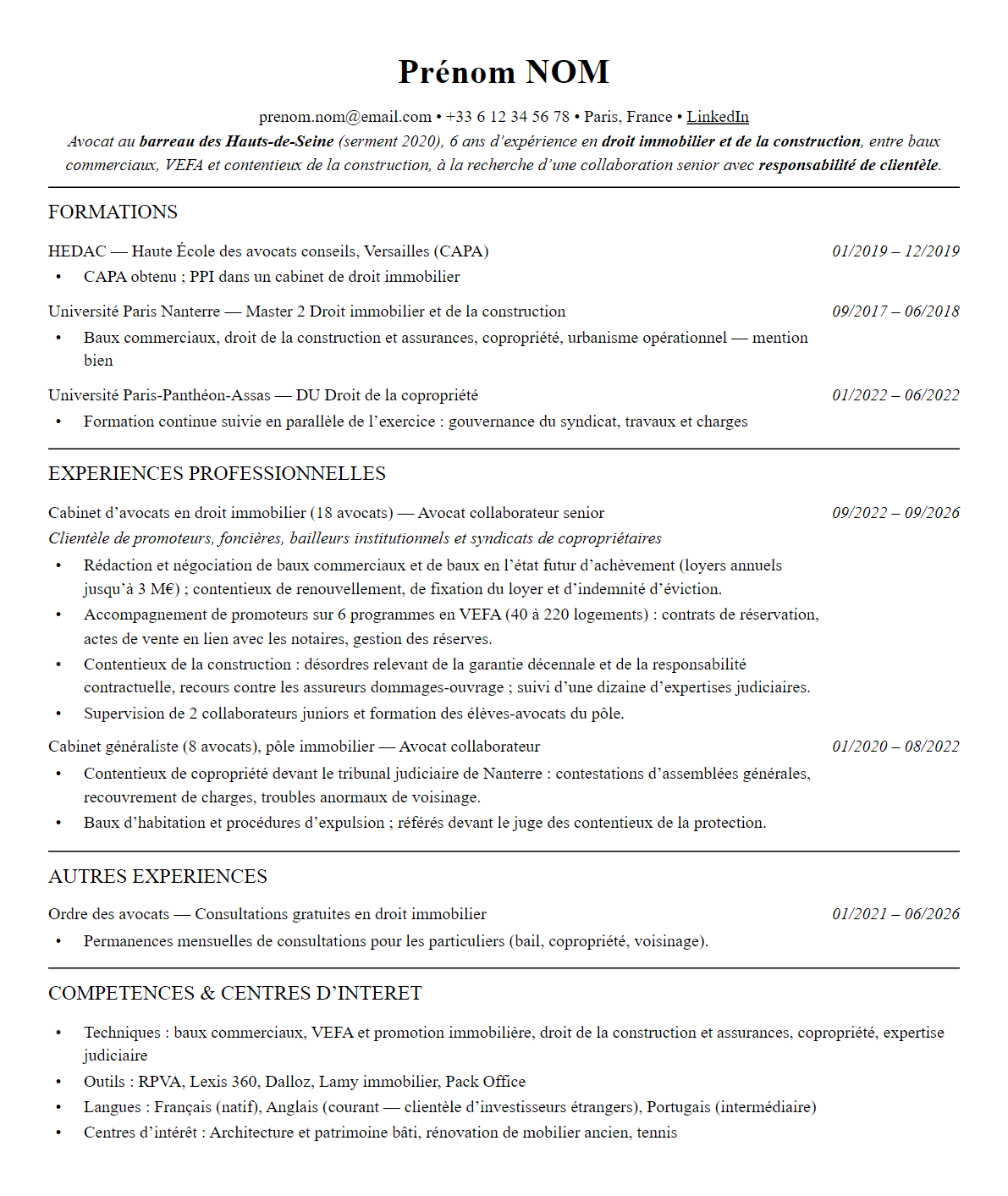
- Header: name, bar of admission and year of swearing-in, phone, email, LinkedIn profile. A title line that positions your practice.
- Professional experience: by firm, in reverse chronological order, with three to five lines of typical matters.
- Education: master's degree (real estate, construction, notarial or public business law), CAPA (French bar qualification), any additional degrees.
- Skills: languages with actual level, research tools (Dalloz, Lexis 360, Lamyline, Doctrine), possibly data room software.
- Additional activities: teaching, publications, involvement in an open bar committee.
If you would rather start from a ready-made base, open the pre-filled real estate lawyer CV and replace the sample matters with your own.
Describing your matters without breaching professional secrecy
Article 2.2 of the French National Internal Rules of the legal profession (Règlement intérieur national, RIN) states that professional secrecy covers, among other things, client names and the lawyer's diary. Leaving out the value of a deal is therefore not enough: the client's name, and any detail that would identify them, has no place on a CV that will circulate outside your firm.
The same Article 2.2 of the RIN provides a narrow exception: when responding to a public or private tender, a lawyer may cite named client references with the client's express prior consent. A CV sent to a firm as part of a job application does not fall within that exception.
Useful anonymisation
Replace identity with a description that keeps the technical interest:
- the type of player: "listed property company", "regional developer", "food retail chain";
- the nature of the transaction: "off-plan acquisition of an office building", "commercial lease renewal with court-set rent";
- your role: drafting, negotiation, advocacy, coordination;
- an order of magnitude only if it cannot identify the deal.
Watch out for overly specific combinations. "Ten-year liability dispute over the office tower delivered in 2023 in La Défense" identifies a site, and therefore a project owner. "Construction dispute over an office building in the Paris region" is enough.
Before and after examples
The examples below describe fictional profiles. Figures only illustrate how to write.
Commercial leases
Before: "Handled commercial lease matters."
After: "Drafted and negotiated commercial leases for a fashion retail chain (around forty sites); handled rent-setting proceedings on lease renewal before the commercial rent judge."
Construction
Before: "Took part in court-appointed expert proceedings."
After: "Assisted a private project owner at six court-appointed expert meetings (waterproofing defects under ten-year liability); drafted submissions to the expert and joined the builders' insurers."
Transactions
Before: "Worked on real estate acquisitions."
After: "Legal due diligence on portfolios of light industrial premises (title, easements, tenancy schedule, planning); drafted due diligence reports and took part in negotiating preliminary sale agreements alongside notaries."
Co-ownership
Before: "Co-ownership litigation."
After: "Represented co-owners' associations in challenges to general meeting resolutions and service charge recovery; drafted submissions independently and pleaded before the judicial court."
The difference comes down to three things: the exact action verb, the named legal framework (lease renewal, ten-year liability, general meeting) and the level of autonomy.
Skills that make a difference
Beyond the law itself, real estate partners value cross-functional skills that deserve a line:
- Technical reading: ability to read an expert report, technical specifications or a handover report, and to talk to an expert or architect.
- Planning law: basics of building permits, third-party appeals and clearing appeal periods, useful even in private practice.
- Basic real estate tax: without claiming to be a tax lawyer, being able to spot a real estate VAT or registration duty question and pass it to the right person.
- Closing management: tracking conditions precedent, coordinating with the notary, the bank and the buyer.
- Legal English if the team works for foreign investors. State a verifiable level (certification, drafting experience in English); see our article on the CV for an international law firm.
Common mistakes
Listing practice areas without matters. A list such as "leases, construction, co-ownership, planning, VEFA" reads like a firm brochure. The partner wants to see what you did, not an inventory of what the firm offers.
Naming clients or transactions. This is the most serious mistake: it raises doubts about your understanding of professional secrecy, a core quality in any hire. Even a deal reported in the press does not allow you to disclose your own or the firm's involvement.
Overstating your role. "Led the acquisition of a portfolio", written by a second-year associate, will be tested at interview. Prefer "worked on…" followed by the specific task you performed.
Leaving out procedure. In real estate litigation, naming the courts (judicial court, summary proceedings judge, court of appeal) and the stages you have handled (expert appointment in summary proceedings, pre-trial management, appeal) shows your real experience.
Ignoring regulatory updates. If you mention an area where regulation has changed, such as energy performance obligations for commercial buildings, check your wording: dated references weaken the whole document.
A two-page CV with little on it. A second page that restates the matters from the first one hinders reading. A dense, well-organised single page is better.
Tailoring the CV to the firm
For a real estate team in a business law firm, highlight due diligence, acquisitions, leases on buildings under construction and coordination with corporate, finance and tax teams.
For a construction boutique, lead with expert proceedings, builders' liability claims and dealings with insurers.
For a local practice handling co-ownership, residential leases and private sales, emphasise volume, court work and relationships with non-professional clients.
In every case, prepare for interview with the same rigour: each line of the CV should be expandable into two minutes of discussion without revealing anything confidential. Our guide to the associate interview at a law firm helps you anticipate the questions.
Frequently asked questions
Can I mention a client's name if the deal was made public?
No, not on a job application CV. The RIN includes client names within professional secrecy, and the publicity of a deal does not lift that secrecy for you. The exception in that same Article 2.2 concerns responses to tenders, with the client's express prior consent.
Should real estate and construction be separated on the CV?
If you practise both, subheadings within each role make reading easier. If one is marginal, group it into a single line so it does not dilute your main practice.
Should I state deal values?
An order of magnitude can help position your matters, provided it does not identify the transaction. In a small local market or for an unusual asset, leave it out.
Is the CNB specialisation essential?
No. It requires at least four years of practice and is a strong signal for experienced profiles, but most practising associates do not hold it. Your matters remain the deciding factor.
How should I present a master's degree in notarial law?
As an asset: it shows command of deeds, land registration and property regimes. Give the exact title and, where relevant, your dissertation if it deals with a real estate topic.
Conclusion
A strong real estate lawyer CV positions your practice in one line, describes precise but anonymous matters and makes your autonomy verifiable. To save time on layout and focus on describing your work, open the pre-filled real estate lawyer CV and adapt it to your background.