
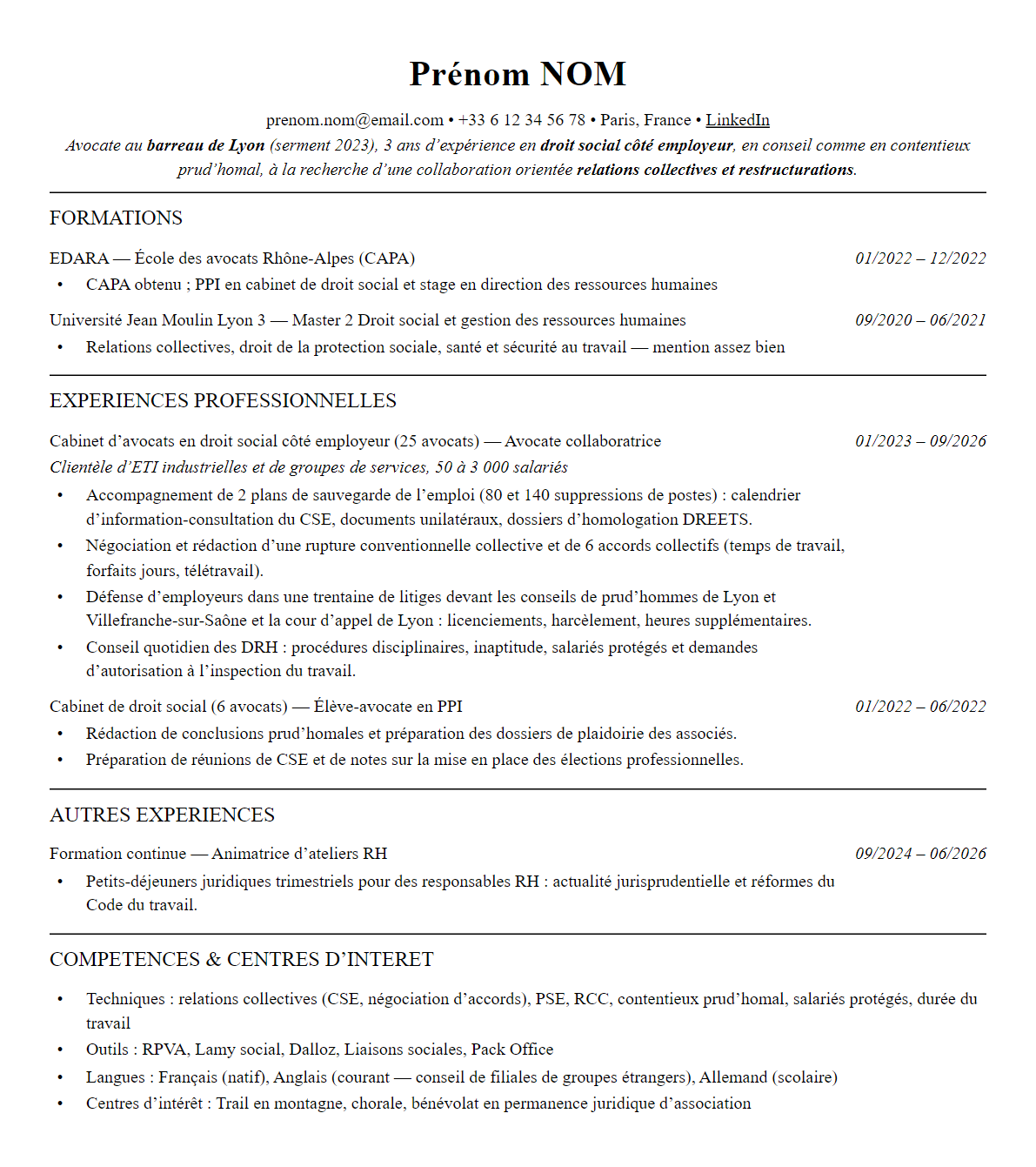
Employment lawyer CV in France: employer side or employee side
Employment law is one of the few practice areas where your side matters as much as your skills. A firm advising HR departments does not recruit quite the same profile as a firm representing employees, senior executives or works councils. Your CV must therefore state clearly which side you have worked for, what you can do in advisory and contentious work, and do so without ever revealing the identity of a company or an employee.
This guide walks you through writing a CV as an employment lawyer in France, whether you are a trainee lawyer, a junior associate or an experienced lawyer looking to join another team.
What employment law partners look for
Which side of the table
Partners first look at the typical clients in your experience: companies, employees, staff representatives, trade unions. A career spent entirely on the employer side is no bar to joining an employee-side firm, but it calls for an explanation, and vice versa. Article 4 of the National Internal Rules of the legal profession (RIN) also requires lawyers to prevent conflicts of interest; a partner will want to check that your arrival creates no difficulty with the firm's matters. Without naming anyone, your CV should let them understand your positioning.
The balance between advisory and litigation
French employment law combines day-to-day advice (employment contracts, working time, disciplinary matters, dismissal procedures, collective bargaining) with often high-volume litigation before employment tribunals (conseils de prud'hommes), courts of appeal and the social chamber of the Cour de cassation. Firms want to know in what proportion you have practised each.
Collective restructurings
Reorganisations, job protection plans (plans de sauvegarde de l'emploi, PSE), collective mutual termination schemes (ruptures conventionnelles collectives), collective performance agreements and the employment aspects of M&A deals are core matters for employer-side firms. If you have worked on them, show your precise role: the works council (CSE) information and consultation timetable, documents submitted to the labour authorities, preparation of meetings.
Keeping up with a fast-moving field
French employment law changes quickly: the compensation scale in Article L. 1235-3 of the Labour Code, case law on annual days-based working time arrangements, on unfairly obtained evidence or on workplace harassment. A short "publications" or "legal updates" section showing you follow these developments is appreciated.
Related areas
Social security litigation (work accidents and employer's gross negligence before the social division of the civil court), employee savings schemes, international mobility and criminal labour law all broaden a profile. The CNB (the national bar council) in fact distinguishes two specialisation certificates: "labour law" and "social security and social protection law".
Recommended structure
- Header: contact details, bar and year of swearing-in, or trainee lawyer status.
- Positioning: one line stating your field and side, for example "Associate, employment law — advisory and litigation, employer side".
- Experience: for each role, one line of context (team size and focus), then three to five lines split between advisory, litigation and collective matters.
- Education: Master 2 in employment law, CRFPA, additional degrees (HR management, social protection).
- Skills: languages, research tools (Liaisons sociales, Lamy, Dalloz, Doctrine), electronic employment tribunal procedure.
- Teaching and publications, where relevant.
You can start from a template already written along these lines: open the pre-filled employment lawyer CV.
Describing your matters without breaching professional secrecy
A particular risk in employment law
Professional secrecy (Article 66-5 of the law of 31 December 1971 and Article 2 of the RIN) covers, among other things, client names and all information in the file. In employment law the risk of identification is high: a job protection plan at an industrial site in a mid-sized town, or a harassment case involving an executive, can often be recognised by cross-referencing the local press.
There is also a human dimension: behind a dismissal case is a person whose situation belongs to their private life. Nothing should allow them to be recognised.
Good practice
- Describe size and sector broadly: "an industrial group with more than 5,000 employees", "a tech start-up", "a retail network".
- Do not give the location of a collective restructuring if that alone identifies it.
- Talk in volumes, not names: "around twenty employment tribunal cases", "a reorganisation affecting several sites".
- Avoid precise dates for matters covered in the media.
- Do not state the outcome of an individual dispute in a way that would allow it to be traced.
Before / after examples
Employer-side employment tribunal litigation
Before:
Handled employment litigation for group X.
After:
Managed a portfolio of around thirty employment tribunal cases for a retail group (gross misconduct dismissals, overtime, days-based working time): drafted submissions, attended conciliation and trial hearings, followed cases on appeal.
Restructuring and job protection plan
Before:
Worked on the PSE at plant Y.
After:
Advised an industrial company on a reorganisation involving a job protection plan: CSE information and consultation timetable, drafting the unilateral document submitted to the regional labour authority (DREETS) for approval, preparing meetings with trade unions.
Employee side
Before:
Defended employees against their employers.
After:
Represented managers and senior executives: negotiated settlement exits, litigated dismissal and harassment cases before the employment tribunal and the court of appeal, analysed non-compete clauses and incentive plans.
Staff representatives
Before:
Advised works councils.
After:
Assisted works councils (CSE) during reorganisation projects: analysis of consultation documents, drafting reasoned opinions, litigation over consultation deadlines.
Advisory
Before:
Drafted employment contracts.
After:
Ongoing advice to HR departments of SMEs and mid-caps: disciplinary procedures, working time arrangements, negotiation of company agreements on remote work and days-based working time.
Common mistakes
- Hiding your side. A CV that is deliberately vague about clients raises suspicion. State your positioning and, if you are switching sides, prepare your explanation for the interview.
- Using the word "specialist" without a certificate. Article 10 of the RIN reserves it for holders of a specialisation certificate issued by the CNB, obtained in particular after four years of professional practice and an interview before a panel. Our article on the CNB specialisation certificate explains the process.
- Confusing collective and individual procedures, or calling a collective mutual termination scheme an "economic redundancy", which it is not. Imprecise terminology is quickly spotted.
- Leaving out social security work when you have handled employer gross negligence or contribution disputes.
- Presenting a case as a win by citing the damages awarded: the information may identify the matter and says nothing about your work.
- Listing short training courses unrelated to your practice.
Tailoring your CV to the firm
Full-service firm with an employment department: highlight the employment aspects of transactions (employment due diligence, transfers of employees under Article L. 1224-1 of the Labour Code, harmonising collective arrangements) and your ability to work in English.
Employer-side employment boutique: emphasise litigation volume, direct relationships with HR departments and your advocacy.
Employee-side or union-side firm: highlight working with individuals, negotiation and experience of works council expert assessments.
Your choice of firm also affects your status: our article on independent or salaried associate status compares the two regimes. If you are considering a move, see also our guide to changing firms.
Conclusion
A successful employment lawyer CV states plainly which side you act for, shows the balance between advisory and litigation, and describes each matter by its nature and your role, never by the identity of the people involved. To save time, open the pre-filled employment lawyer CV and replace the examples with your own practice.
Frequently asked questions
Does employer-side experience prevent me from joining an employee-side firm?
No, but the partner will ask about your motivation and check for conflicts of interest with the firm's matters. A CV that precisely describes the types of matters handled, without identifying clients, makes that check easier.
Should social security matters appear on an employment law CV?
Yes, if they are a real part of your practice. Employer gross negligence cases, work accident recognition and social security contribution audits interest many firms on both sides.
How do I present in-house employment counsel experience?
Describe your work as a lawyer would: procedures conducted, agreements negotiated, litigation managed with external counsel. State the company's size and scope (France, international) without naming the employer if confidentiality is an issue.
Where should an HR management qualification go?
In the education section, after your employment law master's and the CRFPA. It is useful if it informs your practice, for instance in dealing with HR departments or understanding pay policies. One line is enough.