
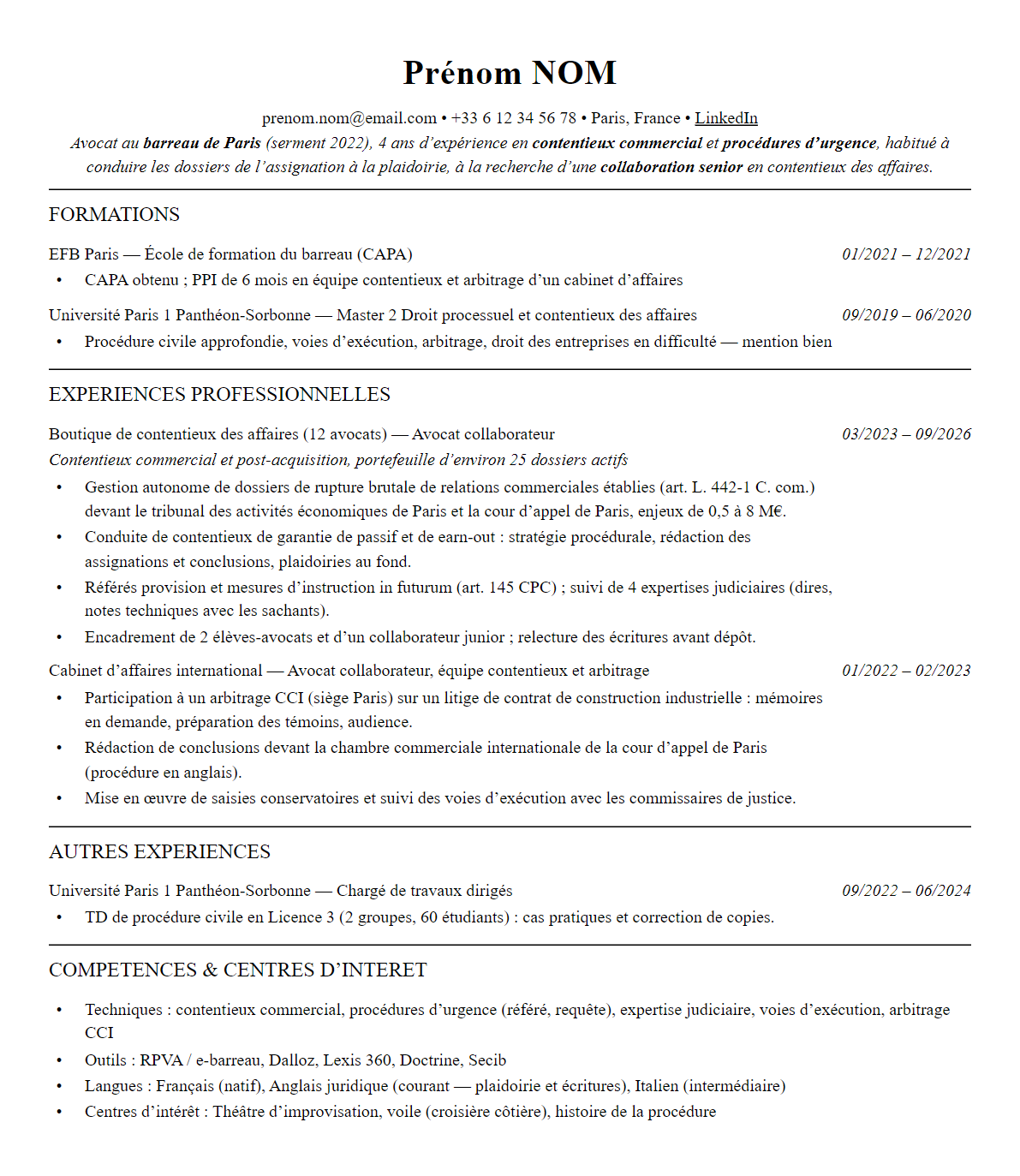
Commercial litigation lawyer CV in France: example and advice
A commercial litigation partner reads a CV the way they read a set of written submissions: looking for structure, relevant facts and evidence for every claim. An associate who writes "handled various litigation matters" tells them nothing. One who specifies the court, the procedural stage and the document they drafted gives the partner, in a few lines, a clear idea of what they could delegate from the first week.
This guide is for trainee lawyers (élèves-avocats), associates with one to eight years of experience and in-house counsel aiming for a litigation department in France. It covers what partners look at, a structure that works, how to describe your matters without breaching professional secrecy, and wording to use or avoid.
What commercial litigation partners look for
Command of procedure, not just substance
Commercial litigation is first and foremost a procedural discipline. A partner wants to know whether you are familiar with the courts where the firm appears and the tools it uses daily: summary proceedings (référés), pre-action evidence-gathering measures under Article 145 of the French Code of Civil Procedure, incidental applications before the pre-trial judge (juge de la mise en état), expedited hearings and enforcement proceedings.
Courts matter. Since 1 January 2025, twelve commercial courts, including those of Paris, Nanterre, Lyon and Marseille, have been replaced on an experimental basis by economic activity courts (tribunaux des activités économiques) for four years (order of 5 July 2024). Using the correct name according to the date of the matter shows you follow developments in your field. The same goes for the international commercial chamber of the Paris Court of Appeal, or for the courts specifically designated to hear claims for abrupt termination of established commercial relationships (Article L. 442-4 of the French Commercial Code).
Drafting ability
A litigation department produces written pleadings. Partners look for evidence of your drafting skills: the type of documents drafted (writs of summons, written submissions, post-hearing notes, ex parte applications), your level of autonomy (first draft or final version), and, where relevant, articles in law journals or moot court competitions.
Handling large files
Court-appointed expert proceedings, post-acquisition disputes, construction or distribution litigation: files often run to thousands of exhibits. Lines showing that you can organise document production, build a chronology or work with forensic accountants and technical experts are reassuring.
Positioning: state courts, arbitration or pre-litigation
A firm with an international arbitration practice will look closely at your languages, your experience with institutions such as the ICC and your knowledge of arbitration rules. A firm focused on French commercial litigation will pay more attention to your practice before commercial courts and courts of appeal. Make your centre of gravity clear at the top of your CV.
Recommended structure
A litigation CV fits on one page up to roughly five or six years of experience. Beyond that, two pages are justified if the second contains useful information rather than detailed descriptions of old internships.
- Header: name, phone, email, bar of admission and year of swearing-in. For a trainee lawyer, state the school (HEDAC, EFB, etc.) and the expected date of the CAPA (the French bar qualification).
- Positioning line: one line, for example "Associate — commercial litigation and arbitration".
- Professional experience: reverse chronological order, three to five lines per role, focused on types of matters and the documents you produced.
- Education: master's degree (Master 2), CRFPA, any LL.M., with honours obtained.
- Languages and tools: your actual level of legal English, legal databases (Dalloz, Lexis 360, Doctrine), electronic filing platforms (e-barreau, RPVA).
- Other activities: teaching tutorials, publications, moot court competitions.
In France, the title "avocat" may only be used after taking the oath and being admitted to a bar. Before that, you are a trainee lawyer, or a CAPA holder awaiting the oath. Any confusion on this point is noticed immediately.
To save time, you can start from a structured base: open the pre-filled litigation lawyer CV, then replace each line with your own matters.
Describing your matters without breaching professional secrecy
What secrecy covers
Lawyers' professional secrecy is set out in Article 66-5 of the French law of 31 December 1971. Article 2 of the National Internal Rules of the legal profession (Règlement intérieur national, RIN) describes it as general, absolute and unlimited in time, and specifies that it covers, among other things, client names, case documents, correspondence and the lawyer's diary. The RIN provides only one narrow exception: in a tender procedure, a lawyer may cite named client references with the client's express prior consent.
A CV sent to a law firm does not fall within that exception. The name of a client, of the opposing party, or any detail enabling them to be identified has no place on it, even if the judgment has been published or the case covered by the press.
The method: nature, stakes, court, stage, role
Replace identity with five elements the partner actually cares about:
- The nature of the dispute: abrupt termination, warranty claim, unfair competition, directors' liability, post-acquisition dispute.
- The industry, described broadly: "a medical equipment distributor", "an investment fund", not a description that points to a single company.
- The court and stage: summary proceedings, first instance, appeal, Supreme Court (with a specialist Conseil d'État and Cour de cassation lawyer), arbitration.
- Your exact role: research, first draft, independent drafting, oral argument, coordinating experts.
- An order of magnitude where this identifies no one: "tens of millions of euros at stake" rather than a precise amount.
Beware of combined clues. "A Lyon-based pharmaceutical laboratory in a dispute with its exclusive distributor in Belgium in 2024" may be enough to identify the parties. Remove one or two elements.
Ongoing matters
For matters not yet decided, stay even more general. A partner from your current firm might read your CV, and a careful recruiter will read an overly precise description as a lack of discretion.
Before / after examples
Summary proceedings and evidence-gathering
Before:
Handled summary proceedings for major clients.
After:
Drafted Article 145 CPC applications and summonses for court-appointed expert proceedings for industrial clients (automotive, energy); carried out three evidence-gathering operations with a commissaire de justice (judicial officer).
Post-acquisition dispute
Before:
Worked on client X's warranty claim against Y.
After:
Warranty and indemnity dispute following the sale of a retail group (tens of millions of euros at stake): first draft of appeal submissions, managed the forensic accounting expert process, prepared the hearing bundle.
Arbitration
Before:
Worked on an international arbitration.
After:
ICC arbitration (seat Paris, English language) between two construction companies: drafted sections of the statement of claim, prepared fact witnesses, managed document production.
Senior associate
Before:
Autonomous on many matters.
After:
Directly managed a portfolio of around fifteen commercial disputes, from strategy to oral argument; supervised two junior associates and a trainee lawyer.
Common mistakes
- Listing subjects instead of work product. "Contract law, competition law, corporate law" does not say what you can do. A line on appellate submissions you drafted says far more.
- Calling yourself a "specialist" without a certificate. Article 10 of the RIN reserves the words "specialist", "specialised", "specialty" and "specialisation" for holders of a specialisation certificate issued by the Conseil national des barreaux (CNB). A CV sent to a firm is not advertising, but the partner reading it knows the rule. Refer to your "main practice area" or simply "commercial litigation". For more, see our article on the CNB specialisation certificate.
- Displaying success rates. "90% of cases won" means nothing in litigation, where outcomes depend on the merits of the file, and professional rules prohibit any misleading or comparative statement.
- Naming clients or opponents, including in a "references" section.
- Forgetting the courts. A litigation CV that mentions no court at all looks theoretical.
- Describing first-year master's internships at length when you have three years as an associate.
Tailoring your CV to the firm
For an international firm, prepare a polished English version and highlight arbitration, cross-border proceedings and coordination with foreign offices; our guide to the English-language lawyer CV for an international firm covers title equivalents. For a litigation boutique, emphasise autonomy, advocacy and direct client contact. For a mid-sized full-service firm, show you can move from a commercial summary proceeding to a commercial lease dispute without a learning curve.
If you are planning a move, also prepare for interview questions about your matters: our article on the associate interview at a French law firm will help you present them orally with the same discretion as on paper.
Conclusion
A strong litigation CV reads like a well-kept list of exhibits: every line proves something, nothing identifies a client, and the partner understands in thirty seconds where you will be useful. To start from a base already written along these lines, open the pre-filled litigation lawyer CV and adapt it to your background.
Frequently asked questions
Can I cite a published decision I worked on?
Secrecy covers client names even when the decision is public. You can mention the nature of the dispute and the court and, with caution, the existence of a published decision on a point of principle, without any reference that would allow the parties to be traced. If in doubt, ask the partner who led the matter.
Should I state the year I was sworn in?
Yes. It lets the partner place your seniority immediately and compare it with the firm's associate levels. Also state your bar of admission.
How do I present in-house experience on a litigation CV?
Highlight managing external counsel, handling litigation risk and preparing cases upstream (gathering documents, building chronologies). Firms value these skills as evidence that you understand what clients expect.
One page or two for a sixth-year associate?
Two pages are acceptable if the second adds useful information: publications, teaching, anonymised representative matters. If it only contains old internships, go back to one page.