
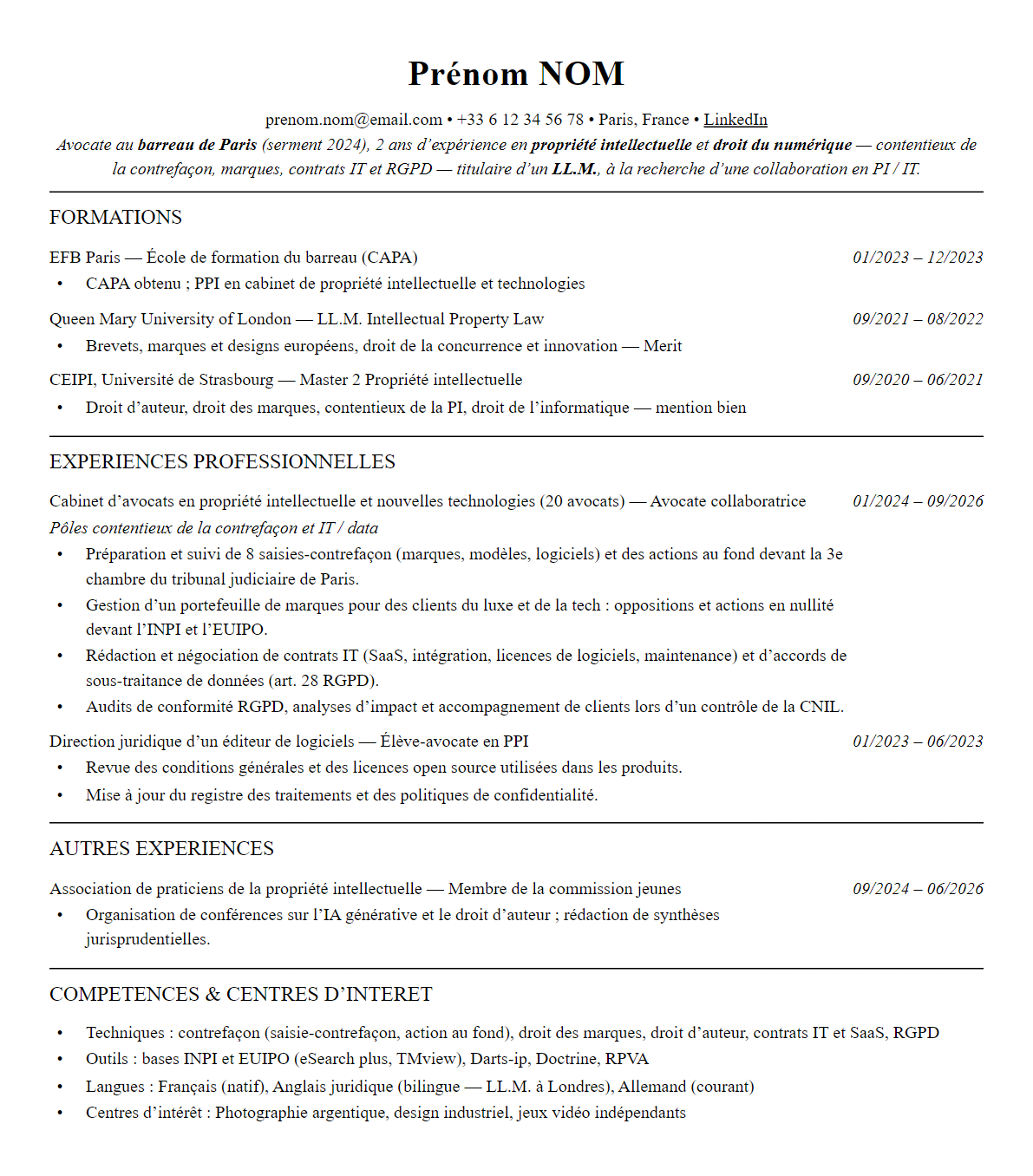
IP and technology lawyer CV in France: intellectual property and digital law
Intellectual property and digital law form a field with shifting boundaries. A single team may handle an opposition to a trade mark application on Monday, a seizure of infringing goods on Tuesday, a software licence negotiation on Wednesday and bringing an online service into line with the General Data Protection Regulation on Thursday. Partners recruiting in these areas therefore need to grasp your core practice quickly: industrial property, copyright, technology contracts, personal data, platform regulation. A CV that lists every label without hierarchy does not help them.
Here is how to build a CV that shows your actual practice while respecting the secrecy owed to clients who are often highly protective of their innovations.
What IP and IT partners look for
The split between rights, litigation and contracts
Partners broadly distinguish three types of practice:
- obtaining and managing rights: filings, clearance searches, oppositions and administrative invalidity or revocation proceedings for trade marks before the French IP office (INPI), available since 1 April 2020 under Ordinance No. 2019-1169 of 13 November 2019, and proceedings before the EUIPO;
- litigation: infringement of trade marks, designs, copyright and patents, unfair competition and free-riding, infringement seizures (saisie-contrefaçon), proceedings before the Paris civil court, which has exclusive jurisdiction over patents in France, and, since 1 June 2023, before the Unified Patent Court;
- advisory and contracts: assignments and licences, integration and outsourcing agreements, terms of service for online platforms, IP portfolio due diligence in acquisitions.
State the share of each in your practice.
Digital regulation
Digital law has expanded considerably at EU level. Beyond the GDPR (Regulation (EU) 2016/679), firms advise on the Digital Services Act (Regulation (EU) 2022/2065), the AI Act (Regulation (EU) 2024/1689) and cybersecurity. Hands-on experience with these texts, such as mapping a platform's obligations or analysing how an AI system is classified, is a strong signal. Stay factual: a partner can tell the difference between keeping up with the news and actual practice.
Technical literacy
For patent litigation and IT contracts, a scientific or engineering background is a recognised asset. Otherwise, partners value evidence of technical familiarity: work with court-appointed IT experts, understanding of software architecture, reading patent claims.
English
IP matters are often international: coordinating filings abroad, parallel litigation in several countries, contracts drafted in English. State a verifiable level and, ideally, drafting experience in English.
Recommended structure
- Header: contact details, bar, year of swearing-in.
- Positioning: "Associate — intellectual property litigation" or "Lawyer — technology contracts and data protection".
- Experience: for each role, one line of context, then lines grouped by practice (rights, litigation, contracts, data).
- Education: Master 2 in intellectual property or digital law, CRFPA, science degree, LL.M.
- Skills: languages, trade mark and patent databases used, legal research tools.
- Publications and teaching: common in these fields and useful if recent.
A template already follows this organisation: open the pre-filled IP lawyer CV.
Describing your matters without breaching professional secrecy
Particularly sensitive information
Professional secrecy, set out in Article 66-5 of the law of 31 December 1971 and detailed in Article 2 of the National Internal Rules of the legal profession (RIN), covers client names and all information in the file. In IP the sensitivity is even greater: a planned filing reveals a product strategy, a portfolio audit hints at an acquisition, and an actual or contemplated infringement action can affect a company's value. Even a filing published on the register should not be linked to your involvement on your CV.
The method
- Name the sector and size: "a luxury house", "a B2B software publisher", "a pharmaceutical laboratory".
- Characterise the rights involved without identifying them: "a portfolio of several hundred trade marks", "a patent covering a medical device".
- State the procedure and court: infringement seizure, action on the merits, opposition, Unified Patent Court proceedings.
- Specify your role: strategy, drafting, coordination with patent and trade mark attorneys or foreign counsel.
- Mention no product, brand or project code name, even internal ones.
Before / after examples
Trade marks
Before:
Managed the trade mark portfolio of fashion house X.
After:
Managed trade mark portfolios for luxury and cosmetics companies: filing strategy, oppositions and invalidity proceedings before the INPI and the EUIPO, coordination of foreign counsel in around fifteen countries.
Infringement litigation
Before:
Infringement seizure against competitor Y.
After:
Design and copyright infringement litigation: applications for infringement seizures, attending seizure operations with a commissaire de justice (judicial officer), writs of summons and submissions before the Paris civil court.
Patents
Before:
Worked on a patent case.
After:
Patent litigation in the medical device sector, working with patent attorneys: infringement and validity analysis, preparing briefs, following proceedings before the Unified Patent Court.
Technology contracts
Before:
Drafted IT contracts.
After:
Negotiated integration, SaaS licence and outsourcing agreements for mid-sized companies, on both customer and supplier side; drafted reversibility, service level and liability clauses.
Data protection and regulation
Before:
GDPR compliance.
After:
Supported an online platform's compliance programme: records of processing, data protection impact assessments, framework for transfers outside the EU, mapping of obligations under the Digital Services Act.
Common mistakes
- Claiming everything. "Trade marks, patents, copyright, IT, GDPR, AI, cybersecurity, e-commerce" in one line reads like a reading list rather than a practice. Prioritise.
- Calling yourself a "specialist" without a certificate. Article 10 of the RIN reserves the word for holders of a specialisation certificate issued by the CNB (national bar council). Three certificates relate directly to these fields: "intellectual property law", "digital and communications law" and "personal data protection law". Our article on the CNB specialisation certificate explains the conditions, including four years of professional practice.
- Confusing lawyers with patent and trade mark attorneys (conseils en propriété industrielle), two separate regulated professions in France. If you have worked at an IP attorney firm, describe your duties precisely.
- Citing recognisable brands or products, including in interests or publications.
- Presenting a technical certification as a legal qualification, or vice versa.
- Piling up tool names unrelated to your practice. Our article on legal tech tools on a lawyer's CV helps you choose the ones that matter.
Tailoring your CV to the firm
IP boutique: highlight the depth of your practice in one niche (trade marks and luxury, patents and life sciences, copyright and media), advocacy and direct client relationships.
IP/IT team at an international firm: emphasise cross-border matters, IP due diligence in acquisitions and drafting in English. Our guide to the English-language lawyer CV will help with that version.
Digital and data-focused firm: focus on compliance projects, dealings with the CNIL (the French data protection authority) and your understanding of digital products.
If you are a senior associate involved in business development, you can say so. Personalised solicitation has been permitted for French lawyers since Decree No. 2014-1251 of 28 October 2014, by post or email and excluding text messages, in compliance with the profession's core principles: describe activities (articles, training sessions, conferences) rather than naming "clients brought in".
Conclusion
An IP and digital law CV should prioritise your practices, demonstrate your technical literacy and describe each matter by the rights, the procedure and your role, never by the client's brand or product. To start from a structured base, open the pre-filled IP lawyer CV and adapt it to your background.
Frequently asked questions
Is an engineering degree essential for patent litigation?
No, but it is valued. Without a scientific background, show that you can work with patent attorneys and experts and understand an invention in a given sector.
Should IP and data protection be separated on the CV?
Yes, if you practise both. Organise your experience by practice and state the share of each. Firms often recruit for a specific team.
How do I present in-house experience at a tech company?
Describe the contracts negotiated, compliance projects led and management of external counsel. Specify the type of company and its sector rather than its products, if these would identify confidential projects.
Do publications on artificial intelligence belong on the CV?
Yes, if they are recent and published in an identifiable legal journal or outlet. Give the title, the publication and the year; keep to the most relevant ones.