
Criminal defence lawyer CV in France: general criminal law and white-collar crime
Criminal law in France covers two worlds that overlap without merging. On one side, general criminal practice: police custody, immediate trial hearings, criminal investigations led by an investigating judge, assize court trials, sentence enforcement. On the other, white-collar crime: investigations by the national financial prosecutor's office (parquet national financier, PNF), corruption, money laundering, misuse of corporate assets, internal investigations and compliance. Firms recruiting in either area do not look for the same signals, but all demand impeccable discretion. A CV that lets a reader guess the identity of a suspect disqualifies its author, however strong their background.
Here is how to build a criminal lawyer's CV that shows your real practice without ever crossing the line of secrecy.
What criminal law partners look for
General criminal practice: experience on the ground
A criminal defence partner wants to know whether you have already been alone with a client in police custody, whether you know the pace of immediate trial hearings (comparutions immédiates) and whether you can spot a procedural nullity. What counts:
- duty lawyer rotas and court-appointed (commission d'office) cases;
- assistance during police custody (garde à vue) and voluntary interviews;
- judicial investigation practice: requests for investigative steps, nullity applications before the investigation chamber, hearings before the liberty and custody judge;
- criminal trials, before the assize court or the departmental criminal court;
- juvenile justice, governed since 30 September 2021 by the Juvenile Criminal Justice Code;
- sentence enforcement.
White-collar crime: rigour and business understanding
White-collar crime firms look for profiles able to analyse accounts, conduct an internal investigation and work with legal and compliance departments. Useful signals:
- experience of preliminary police investigations and judicial investigations in economic and financial matters;
- knowledge of judicial public interest agreements (CJIP, Article 41-1-2 of the Code of Criminal Procedure, the French equivalent of a deferred prosecution agreement) and dealings with the PNF;
- compliance programmes under Law No. 2016-1691 of 9 December 2016, known as Sapin II, and audits by the French Anti-Corruption Agency (AFA);
- administrative enforcement proceedings, for example before the enforcement committee of the Autorité des marchés financiers;
- English, often essential in cross-border matters.
Advocacy
Criminal law remains a courtroom discipline. Taking part in an advocacy competition, being elected secretary of the Conférence (a prestigious advocacy distinction) at bars that hold one, or regular oral advocacy are all points partners read closely.
Recommended structure
- Header: contact details, bar, year of swearing-in.
- Positioning: "Criminal defence lawyer — defence and judicial investigations" or "Associate — white-collar crime and compliance".
- Experience: for each role, one line of context (type of firm, general criminal or white-collar focus), then three to five lines focused on proceedings and your role.
- Bar activities: duty rotas, court appointments, Conférence, training delivered.
- Education: Master 2 in criminal law or criminology, CRFPA, possibly accounting or compliance training for white-collar work.
- Languages and skills: languages, research tools, electronic communication with the courts.
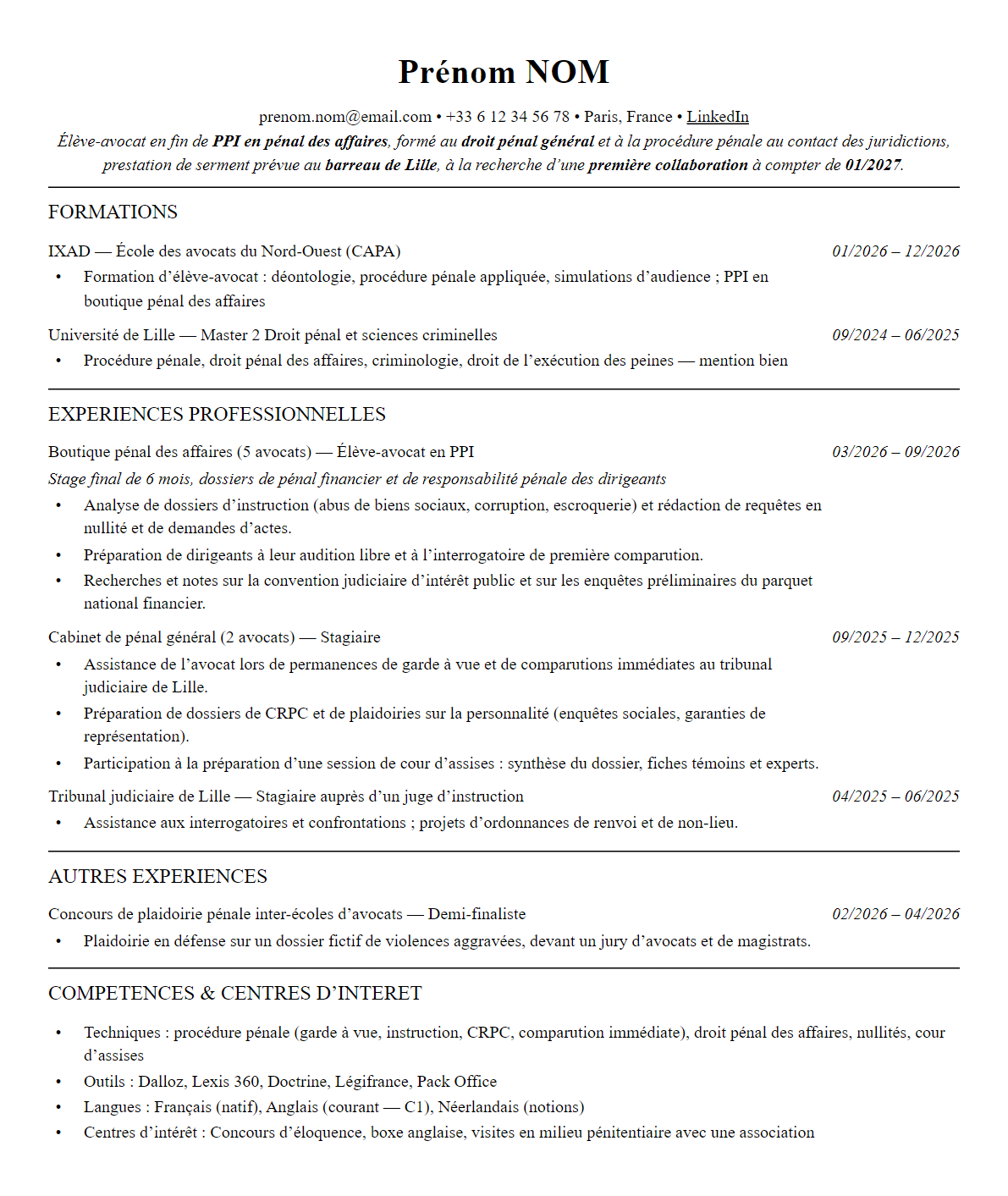
To get started quickly, you can open the pre-filled criminal lawyer CV, which follows this structure.
Describing your matters without breaching secrecy
Two layers of secrecy
In criminal matters, two obligations overlap. The lawyer's professional secrecy, set out in Article 66-5 of the law of 31 December 1971 and described in Article 2 of the National Internal Rules of the legal profession (RIN) as general, absolute and unlimited in time, covers your clients' names and all information in the file. Investigative secrecy, laid down in Article 11 of the Code of Criminal Procedure, protects ongoing proceedings; Article 114-1 of the same code also penalises passing on to a third party copies of investigation documents given to a party.
The practical consequence is simple: no names, no arrest dates, no locations, and no unusual offence linked to a town or a profession should appear on your CV. The fact that a case has been widely covered in the press does not lift secrecy; it is precisely where the risk of identification is highest.
The method
Describe matters by category and volume:
- the nature of the offences, grouped: "offences against the person", "drug offences", "offences against probity";
- the procedural stage: police custody, judicial investigation, criminal court hearing, assize court, appeal, sentence enforcement;
- volume: "around fifty duty sessions", "about ten judicial investigations followed";
- your role: assistance, drafting applications, oral argument, working with experts.
Avoid any mention of the outcome of an individual case ("acquittal obtained in the X case"). Beyond the risk of identification, an outcome depends on many factors unrelated to the lawyer, and Article 10 of the RIN prohibits misleading statements.
Before / after examples
Duty rotas and police custody
Before:
Numerous police custody cases handled.
After:
Assisted clients in police custody and voluntary interviews as part of bar duty rotas (around sixty interventions); defended clients at immediate trial hearings before the criminal court.
Serious crime investigations
Before:
Defended Mr X in the Y murder case.
After:
Followed criminal judicial investigations alongside the partner: drafted requests for investigative steps and nullity applications, prepared client interviews with the investigating judge, prepared the assize court trial.
White-collar crime
Before:
Worked on the PNF investigation into company Z.
After:
Defended companies and executives in investigations into offences against probity: analysed financial flows with a forensic accountant, prepared interviews, contributed to negotiating a judicial public interest agreement.
Internal investigation
Before:
Fraud audit at a client.
After:
Conducted internal investigations following whistleblower reports (fraud, corruption): defined scope, document review, conducted interviews, reported to the audit committee.
Civil parties
Before:
Represented victims.
After:
Represented civil parties, individuals and associations, before the criminal court and the assize court: civil party applications, quantifying damages with medical experts.
Common mistakes
- Referring to a high-profile case, even without names, through a description that makes it recognisable.
- Displaying a track record: number of acquittals, dismissals or sentences avoided. This is misleading and dangerous for secrecy.
- Calling yourself a "criminal law specialist" without a certificate. "Criminal law" is one of the specialisation certificates listed in the amended order of 28 December 2011; Article 10 of the RIN reserves the word "specialist" for certificate holders. See our article on the CNB specialisation certificate.
- Mixing general criminal and white-collar work without hierarchy. If you are applying to a white-collar crime firm, put those matters first, even if they were a smaller share of your past practice.
- Leaving out duty rotas and court appointments because they seem "less serious": for a criminal defence partner, this is where defence skills are learned.
- Using imprecise terminology: "trial" for a case management hearing, or the outdated "inculpé" instead of "mis en examen" (placed under formal investigation).
Tailoring your CV to the firm
Criminal defence firm: highlight courtroom experience, working with clients in detention and availability (duty rotas, emergencies).
White-collar crime firm: emphasise business understanding, compliance, languages and the ability to work with corporate or litigation teams.
Criminal team within a business law firm: show you can work with other departments and handle cross-border matters.
Starting your career? Our guide to the CV for a first associate position will help you make the most of your internships. And remember to align your CV with your LinkedIn profile as a lawyer, applying the same rules of discretion.
Conclusion
A criminal lawyer's CV should reflect what a partner expects in court: precision, composure and absolute discretion. Describe your proceedings, your work and your volumes; leave out names, places and outcomes. To start from a solid base, open the pre-filled criminal lawyer CV and adapt each line to your practice.
Frequently asked questions
Can I mention that I have pleaded before an assize court?
Yes, in general terms: "defence advocacy before the assize court" reveals no information covered by secrecy, provided you give no date, place or precise description of the facts.
Do court-appointed duty cases belong on a white-collar crime CV?
Yes, in one line. They demonstrate your command of criminal procedure and courtroom work, which is useful in any criminal matter, including economic ones.
How do I highlight in-house compliance experience?
Describe the programmes you put in place (risk mapping, third-party due diligence procedures, whistleblowing system) and your work with external counsel. These skills transfer directly to white-collar crime practice.
Should the title of secretary of the Conférence appear at the top of my CV?
It can go in the header or in a section dedicated to bar activities. It is a distinction well known to criminal lawyers; state the year and the bar.